How to Invest in Hedge Funds: It is not difficult to invest in hedge funds but it does take a considerable investment of time or advice from a trained and licensed hedge fund consultant to make sure you avoid common pitfalls or over-concentration in one type or highly correlated investment portfolio. This article is not written as a piece of financial advice or an offering of services, but simply as a way to de-mystify how the process of investing in hedge funds actually works.
6 tips for those who want to know how to invest in hedge funds:
1. Make sure you are a accredited investor.
2. Learn everything you can about hedge funds, if you have the time. Read this hedge fund blog, read news articles, skim through white papers, download the free hedge fund blog book and review commentary written by hedge fund managers. Try to speak to friends who personally work with hedge funds or have invested in hedge funds in the past.
Only work with licensed hedge fund consultants and hedge fund brokers who also ensure that you are an accredited investor. Use what you have learned in your research to work with someone who is honest and not overly bias towards certain types of funds that might not be right for you.
3. Include your day-to-day financial advisor through the whole process of investing in Hedge Funds. In fact, they probably know a good person to contact regarding this process.
4. Consider using Fund of Hedge Funds.
5. Never bet the house on a single strategy. Consult your regular day-to-day financial advisors to help you construct a portfolio of investments that makes sense for your financial position and goals.
6. Keep informed. Ask to directly receive monthly or quarterly updates from the hedge fund manager and stay actively involved. Learn what types of market movements affect your hedge fund the most and keep tabs on them and trends that might affect them.
Note: This post on How to invest in hedge funds is not financial advice or a solicitation to sell hedge funds. None of what I write in the Richard Wilson Hedge Fund Blog is ever an offer of financial or investment advice. This is a forum for ideas, networking, tips, and leads. Please comment with any ways I could improve this posting. Thanks in advance.
This section details some of the important events in the history of hedge funds.
Back in 1949, Alfred Winslow Jones, a former reporter for Fortune, started the first hedge fund with an initial capital of only US$100 000. Jones’ core intuition was that by correctly combining two speculative techniques, i.e. using both short sales and leverage, it would be possible to reduce total portfolio risk and construct a conservative portfolio, featuring a low exposure to the general market performance. Jones also had two other major ideas: to cater to investors, he had invested all his savings in the fund he managed, and his profit came from a 20% stake in the generated performance rather than from the payment of a fixed
percentage of assets under management. This approach made it possible to bring the interests of manager and investor together.
Today, the archetype described above characterizes only a small number of hedge funds: the term is now used to refer to a vast realm of different management models. At present, a hedge fund has five main characteristics:
The manager is free to use a wide range of financial instruments.
The manager can short sell.
The manager can use leverage.
The manager’s profit comes from a management fee, which is fixed and accounts for 1.5–2.5 %, and from a 20–25% fee on profits. Generally, the performance or incentive fee is applied only if the value of the hedge fund unit grows above the historical peak in absolute terms or over a one-year period.
The manager invests a sizable part of his personal assets in the fund he manages, so as to bring his own interests in line with those of his clients.
In 1952, Jones opened up his partnership to other managers and started to hand over to them the management of portions of the portfolio, and within a short period of time he assigned them the task of picking stocks. Jones would allocate the capital among his managers, monitor and supervise all investment activities and manage the company’s operations. The first hedge fund in history turned into the first multi-manager fund in history.
In 1967, Michael Steinhardt started Steinhardt, Fine, Berkowitz & Company with eight employees and an initial capitalization of $7.7 million. Steinhardt began his career as a stock picker and then, as his hedge fund grew, shifted to a multi-strategy fund. In the 1980s Steinhardt became head of a hedge fund group with roughly US$5 billion of assets under management and with over 100 employees. Steinhardt ended his hedge fund career in 1995 after suffering big losses in 1994.
By 1969, the US Securities and Exchange Commission (SEC) had started to keep a watchful eye over the blossoming industry of hedge funds as a result of the rapid growth A Few Initial Remarks 3 in the number of new hedge funds and of assets under management. At that time, the commission estimated that approximately 200 hedge funds were in existence, with $1.5 billion of assets under management. 1969 was also the year that George Soros created the “Double Eagle” hedge fund, the predecessor of the more renowned Quantum Fund.
The first fund of hedge funds1 was Leveraged Capital Holdings, created in Geneva in 1969 by Georges Karlweis of Banque Privée Edmond de Rothschild, which had the purpose of investing in the best single-managers of the time. Leveraged Capital Holdings also represents the first European hedge product.
In 1971, the first US fund of funds was started by Grosvenor Partners, and in 1973, the Permal Group launched the European multi-manager and multi-strategy fund of funds, called Haussmann Holdings N.V. The people who were given the task of creating the investment team for Permal were Jean Perret and Steve Mallory (hence the name Permal).
Then, in 1980, Julian Robertson and Thorpe McKenzie created Tiger Management Corporation and launched the hedge fund Tiger with an initial capital of $8.8 million. In 1983, Gilbert de Botton started Global Asset Management (GAM), a company specializing in the management of funds of hedge funds, which in 1999 was acquired by UBS AG and by the end of 2004 had some E38 billion of Assets under Management (AuM).
At the beginning of the 1990s, Soros, Robertson and Steinhardt managed macro funds worth several billion dollars and invested in stocks, bonds, currencies and commodities all over the world, trying to anticipate macro-economic trends.In 1992, alternative investment instruments started to draw the attention of the press and of the financial community, when George Soros’s Quantum Fund made huge profits anticipating the depreciation of the British pound and of the Italian lira.
The early 1990s were the heyday of macro funds. The exit of the British pound and the Italian lira from the European Monetary System in September 1992 allowed Soros to cash in an incredible profit of $2 billion.
On 4th February 1994, the Fed unexpectedly introduced the first rate hike of one quarter of a percentage point, which caused US treasuries to topple and led to a temporary drain of liquidity on the markets. The twin effect of panic on the markets and leverage proved disastrous for Steinhardt Partners, which in 1994 suffered a loss of 31 %. Steinhardt decided to retire at the end of 1995, despite the fact that during that year he had been able partly to recover the 1994 losses, ending 1995 up 26 %.
Later on, hedge funds bounced back into the headlines when in the first nine months of 1998 Long Term Capital Management, managed by John Meriwether and a think tank including two Nobel laureates in Economics (Myron Scholes and Robert Merton), generated a staggering $4 billion loss, starting a domino effect that left many banks, financial institutions and big brokers in many countries teetering on the brink of default. Only the prompt intervention of a bail-out team led by the Federal Reserve of Alan Greenspan avoided the onset of a systemic crisis.
In October 1998, when the Japanese yen appreciated against the dollar, Robertson suffered a loss of about $2 billion. In 1999, his long/short equity strategy, based on the analysis of fundamentals of listed companies, did not work at all in the market driven by the tail wind of the New Economy. After withdrawals from investors, assets under management had plunged from $25 billion in August 1998 to less than $8 billion at the end of March 2000.
At the end of March 2000, when the “dot-com” speculative bubble was at its peak, Robertson announced the liquidation of the Tiger Fund. In April 2000, George Soros changed his chief investment strategist and soon after the CEO of Soros Fund Management LLC as well. Soros announced to his investors that he would stop making large leveraged macro investments. To reduce the risk he would downsize his return objectives.
This article is a part of “Investment Strategies of Hedge Funds” ebooks by Filippo Stefanini for closed private educations only. You should nuy his books for the best completely informations.
In the United States, the country where they first appeared and enjoyed the greatest development, there is no exact legal definition of the term “hedge fund” that outlines its operational footprint and gives a direct understanding of its meaning.
Yet, to rely on the literal meaning of hedge fund, i.e. “investment funds that employ hedging techniques”, could be misleading, because it relates merely to just one of the many traits of hedge funds and makes reference to only one of the many investment techniques they deploy.A more fitting definition in our opinion is the following: “A hedge fund is an investment instrument that provides different risk/return profiles compared to traditional stock and bond investments”.
To appreciate the meaning fully, however, it is necessary to remark that hedge funds make use of investment strategies, or management styles, that are by definition alternative, and that they do not have to fulfill special regulatory limitations to pursue their mission: capital protection and generation of a positive return with low volatility and low market correlation. Hedge funds are set up by managers who have decided to take the plunge into selfemployment, and whose backgrounds can be traced to the world of mutual funds or proprietary trading for investment banks.
The differences between hedge funds and mutual funds are manifold. The performance of mutual funds is measured against a benchmark, and as such it is a relative performance. A mutual fund manager considers any tracking error, i.e. any deviation from the benchmark, as a risk, and therefore risk is measured in correlation with the benchmark and not in absolute terms. In contrast, hedge funds seek to guarantee an absolute return under any circumstance, even when market indices are plummeting. This means that hedge funds have no benchmark, but rather different investment strategies.
Mutual funds cannot protect portfolios from descending markets, unless they sell or remain liquid. Hedge funds, however, in the case of declining markets, can find protection by implementing different hedging strategies and can generate positive returns. Short selling gives hedge fund managers a whole new universe of investment opportunities. It is not the general market performance that counts, but rather the relative performance of stocks. The future return of mutual funds depends upon the direction of the markets in which they are invested, whereas the future return of hedge funds tends to have a very low correlation with the direction of financial markets.
Another major difference between hedge funds and mutual funds is that the latter are regulated and supervised by Regulatory Authorities, and are bound by limitations restricting their portfolio makeup and permitted instruments. Moreover, investors are further protected by obligations burdening the management company in terms of capital adequacy, proven robust organization and business processes. On the contrary, the absence of a stringent 2 Investment Strategies of Hedge Funds regulatory framework for hedge funds leaves the manager with greater latitude to set up a fund characterized by unique traits in terms of the financial instruments to be employed, the management style, the organizational structure and the legal form.
Therefore, the hedge fund industry is marked by a great heterogeneity, in that it is characterized by different investment strategies and by funds of a wide variety of sizes. Although hedge funds immediately bring to mind the image of innovative investment strategies within the financial landscape, the first hedge fund came into existence more than half a century ago.
This article is a part of “Investment Strategies of Hedge Funds” ebooks by Filippo Stefanini for closed private educations only. You should buy his books for the best completely informations.
The following charts give precise details on the correlation between two parities. They show the history and the distribution of the correlation over a given period. The use is relatively simple, you must give the two parities which you want to compare as well as the number of points to calculate the correlation.
The result is given with graphics representation of the hourly and daily correlation. The historical graph is in a traditional representation. The graphics of the distribution of the correlation are given with a polar plot whose reading is rather simple:
if all the points are grouped that means that the correlation is constant over the period. In this case if the points are on the left the correlation is negative, on the right the correlation is positive.
if all points are dispersed that means that the correlation is not constant in time, the index of correlation is not usable for trader, it is not significant.
In other chapters of Mataf.net you will be able to calculate the correlation of a pair compared to a basket of currencies and to see the complete table of the cross correlations.
In this part you will be able to have a total sight of the correlation of a pair versus the market. You must select the parity you want to analyse then to give the number of points on which the correlation will be calculated and finally to select the basket of pairs.
The result is given with Radar plots representing the hourly and daily correlation. More the points are located outside more the correlation is strong. In the event of negative correlation you will see appearing a sign "-" in front of the name of the parity.
In other chapters of Mataf.net you will be able to calculate the cross correlation of a basket of currencies and to study more precisely the correlation between two parities.
The following tables represent the correlation between the various parities of the foreign exchange market (forex). The correlation coefficient highlights the similarity of the movements between two parities.
If the correlation is high (above 80) and positive then the currencies move in the same way.
If the correlation is high (above 80) and negative then the currencies move in the opposite way.
If the correlation is low (below 60) then the currencies don't move in the same way.
The correlation index are calculated on the daily and hourly data. In other chapters of Mataf.net you will be able also to calculate the correlation of a pair compared to a basket of currencies and to study more precisely the correlation between two parities.
The following tables represent the correlation between the various parities of the foreign exchange market (forex).
The correlation coefficient highlights the similarity of the movements between two parities.
If the correlation is high (above 80) and positive then the currencies move in the same way.
If the correlation is high (above 80) and negative then the currencies move in the opposite way.
If the correlation is low (below 60) then the currencies don't move in the same way.
The correlation index are calculated on the daily and hourly data. In other chapters of Mataf.net you will be able also to calculate the correlation of a pair compared to a basket of currencies and to study more precisely the correlation between two parities.
Some currencies tend to move in the same direction, some — in opposite. This is a powerful knowledge for those who trade more than one currency pair. It helps to hedge, diversify or double profitable positions.
Statistically measured by performance, currency pairs are given so called "correlation coefficients" from +1 to -1.
A correlation of +1 means two currency pairs will move in the same direction 100% of the time. A correlation of -1 means they will move in the opposite direction 100% of the time. A correlation of zero means no relation between currency pairs exists. Information about current correlation coefficients can be found here: Currency Correlations Table
The example of strong positive correlation between two currency pairs is: GBP/USD and EUR/USD. They have a correlation coefficient of over +0.90, which means that when EUR/USD goes up, GBP/USD also goes up.
A well known sample of two opposite moving currency pairs is EUR/USD and USD/CHF, they have very high coefficient of over -0.90, which means that they move inversely almost 100% of the time!
Examples of same direction moving currency pairs are:
EUR/USD and GBP/USD
EUR/USD and NZD/USD
USD/CHF and USD/JPY
AUD/USD and GBP/USD
AUD/USD and EUR/USD
Inversely moving pairs are:
EUR/USD and USD/CHF
GBP/USD and USD/JPY
GBP/USD and USD/CHF
AUD/USD and USD/CAD
AUD/USD and USD/JPY
How a trader can use this information?
1. A very simple use is avoiding trades that cancel each other. For instance, knowing that EUR/USD and USD/CHF move inversely near-perfectly, there would be no point to go short on both positions as they eventually cancel each other (loss + profit).
1.a. However, there is a strategy of hedging one currency pair with another. Lets' take the same pairs: EUR/USD and USD/CHF. For example, a trader has opened long positions on both currency pairs. Since they move in opposite directions, if EUR/USD is making some losses, the other pair will go in profit. Hence, the total loss will not be as bad as if it would be without the second "backup trade". On the other hand, profits here are not large either.
2. When confident, a trader may double position size by placing same orders on parallel (moving in the same direction) currency pairs.
3. Another option would be to diversify risks in trade. For instance, AUD/USD and EUR/USD pairs have the correlation coefficient of about +0.70 which means that pairs are moving mostly in the same direction but not as perfect (which is what we need here). If we decide that USD is going to weaken, for example, we will go long and place half of buy order on AUD/USD currency pair, and half on EUR/USD. Splitting the orders will preserve trader's positions from sudden losing rallies (sudden "jumps" in price); and as these currencies move not 100% identical a trader will have some time to react adequately. Different monetary policies of different countries' banks also create an impact: when one currency will be less affected than the other and therefore will move slower.
The concept of hedge trading is simple enough. Market mavens estimate that most currency pairs move within defined ranges for approximately 80% of the time. When a breakout from such a range occurs, it tends to be sudden and sharp, the sort a trader wants to catch; however, for those who cannot sit and watch the market constantly, these can also be the moves that are easiest to miss, especially if one is asleep when the active London market opens at 8:00 AM GMT or one has misjudged the release of a particularly meaningful fundamental announcement.
It’s easy enough to set a market order at a pre-determined entry point and walk away from the computer; however, the value of that technique depends entirely upon the accuracy of one’s estimate of the market’s future direction, which of course in turn depends upon one’s proficiency in technical analysis and predicting a nation’s economic data prior to its release—not the easiest of tasks in recent months, as a well-known bank’s complete miscall of the RBNZ policy statement, released 5 June 2008, illustrates all too well.
Rather than depend upon a market forecast, no matter how carefully prepared, savvy forex traders prefer to hedge their bets and place two entry orders, one above and one below a currency pair’s trading range, and catch the market’s move whichever direction it goes.
Examine the following chart. This is the four-hour chart of the NZD/USD from late May and early June:
==========
Since 22 May, the NZD/USD has wavered between resistance at 0.7925 and support at 0.7764. With fundamentals roughly balanced—a slowdown in the U.S. versus a potential downturn in New Zealand—only a clear signal of a change in monetary policy from one of the two central banks in question was likely to break the deadlock any time soon.
It was possible, of course, to probe the fundamentals more deeply, to spend an hour analyzing the chart, or to entrust one’s money to the forecastof a trusted analyst; however, the only certain means of catching this breakout was to sit and watch the chart, or place hedge trades above and below the channel.
On the NZD/USD chart above, note that the lines delineating the range are drawn just beyond the extent of the heikin ashi within. When using hedge trades, it’s a good idea to draw one’s channel a bit roomier than normal, leaving room for unpredictable spikes that could penetrate the range, trigger an order, and then withdraw, losing money rather than making it. That remains a risk with any forex trade, of course, but it makes sense to give away a few pips and lower that risk.
Also, ensure that one’s broker offers the feature known as “order cancels order,” meaning that when one order is triggered, the other is automatically nullified. That way, one doesn’t have a loose trade floating about, waiting to be activated when it’s least desired, and often when one is not watching.
The NZD/USD, of course, fell off the table when the RBNZ’s policy statement turned out to be much more dovish than the market anticipated, and it’s still falling as this is written:
For those who weren’t watching their monitors at the moment the movement began, pre-arranged hedge trades would have garnered an easy hundred pips.
source : http://forextradings.com.au
Sometimes the charts of different currency pairs echo each other’s movements, and sometimes they seem to move as opposites. This phenomenon is known as positive or negative correlation within the forex trading market, and it can be a powerful tool for savvy traders.
There are all sorts of reasons for correlation, for example, different monetary policies, changes in commodity prices, and various economic and political situations.
With the fluidity of global economics, such as diverging monetary policies between nations and the ups and downs of the commodities markets, correlation between sets of currency pairs does change over time. However, certain trends tend to remain static. For example, NZD/USD and AUD/USD tend toward fairly strong positive correlation despite the significant differences in the economic situations of Australia and New Zealand.
On the other hand, EUR/USD and USD/CHF generally have a fairly strong negative correlation, with the lower liquidity of the Swissie giving it greater volatility. Therefore, when the USD/CHF is bullish, traders historically expect the EUR/USD to become bearish, and vice versa.
Statistical techniques have been established to measure degrees of correlation. The most commonly used system illustrates that degree with a coefficient between +1 and –1, where +1 indicates two currency pairs that move in perfect synchronisation, –1 indicates two currency pairs that move as mirror images, and 0 indicates there is no correlation between the two pairs and they move at random.
There are many sets of correlation tables for the most actively traded currency pairs available online, so there’s no need for each trader to calculate their own set to trade the majors. However, for less actively traded currency pairs, calculating correlations can be accomplished with a spreadsheet program such as Excel and by downloading historical price tables from one’s online forex trading platform.
Correlation is calculated over different periods of time, with the most common intervals being one month, three months, six months, and one year. Comparing degrees of correlation over time emphasizes the overall volatility of the forex trading market and helps traders to plan their portfolio, particularly as regards exposure.
Correlation is important for all traders. Technical analysts know that, when the chart of one currency pair shows a certain promising pattern, strongly correlated pairs are also worth examining. As a hypothetical example, if EUR/USD signals a break above a trendline, one should examine GBP/USD for a similar pattern, and USD/CHF for its reverse.
The fundamental analyst can use correlation in several ways. First, knowing currency pair correlations helps one avoid contradictory positions, e.g., going long on both the EUR/USD and USD/CHF makes no sense as with their strong negative correlation, the loss suffered from one trade would cancel out the profit earned from the other.
Another fundamental use for correlation is to diversify one’s portfolio by using currency pairs with strong but not absolute correlation to strengthen one’s position within the market. An example would be going long on both the EUR/USD and GBP/USD. With a positive correlation of 0.71 over the twelve months preceding November 2007, holding such a position spreads the trader’s risk while still remaining USD bearish overall.
source : http://forextradings.com.au
To be an effective trader, understanding your overall portfolio's sensitivity to market volatility is important. But this is particularly so when trading forex. Because currencies are priced in pairs, no single pair trades completely independently of the others. Once you know about these correlations and how they change, you can take advantage of them to control over your portfolio's exposure.
Defining Correlation The reason for the interdependence of currency pairs is easy to see: if you were trading the British pound against the Japanese yen (GBP/JPY pair), for example, you are actually trading a kind of derivative of the GBP/USD and USD/JPY pairs; therefore, GBP/JPY must be somewhat correlated to one if not both of these other currency pairs. However, the interdependence among currencies stems from more than the simple fact that they are in pairs. While some currency pairs will move in tandem, other currency pairs may move in opposite directions, which is in essence the result of more complex forces.
Correlation, in the financial world, is the statistical measure of the relationship between two securities. The correlation coefficient ranges between -1 and +1. A correlation of +1 implies that the two currency pairs will move in the same direction 100% of the time. A correlation of -1 implies the two currency pairs will move in the opposite direction 100% of the time. A correlation of zero implies that the relationship between the currency pairs is completely random.
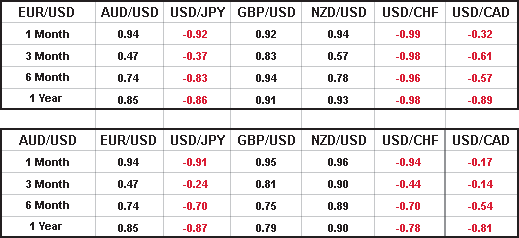
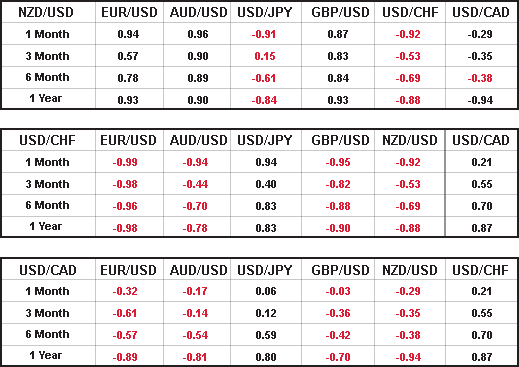
Reading The Correlation Table With this knowledge of correlations in mind, let's look at the following tables, each showing correlations between the major currency pairs for the month of March 2005.
The upper table above shows that over the month of March (one month) EUR/USD and AUD/USD had very strong positive correlation of 0.94. This implies that when the EUR/USD rallies, the AUD/USD will also rally 94% of the time. Over the longer term (three months), though, the correlation is slightly weaker (0.47).
In contrast, the EUR/USD and USD/CHF had a near-perfect negative correlation of -0.99. This implies that 99% of the time, when the EUR/USD rallies, USD/CHF will undergo a selloff. This relationship even holds true over longer periods as the correlation figures remain relatively stable.
Yet correlations do not always remain stable. Take USD/CAD and NZD/USD, for example. With a coefficient of -0.94, they had a strong negative correlation over the past year, but the relationship deteriorated over March 2005 for a number of factors, including the Reserve Bank of New Zealand's intentions to resume rate hikes, and political instability in Canada.
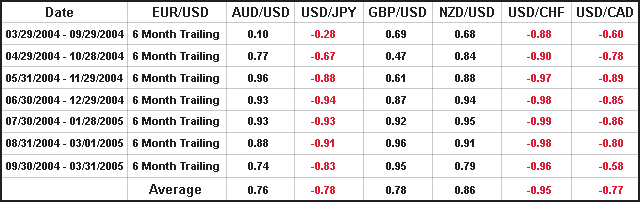
Correlations Do Change It is clear then that correlations do change, which makes following the shift in correlations even more important.Sentiment and global economic factors are very dynamic and can even change on a daily basis.Strong correlations today might not be in line with the longer-term correlation between two currency pairs.That is why taking a look at the six-month trailing correlation is also very important.This provides a clearer perspective on the average six-month relationship between the two currency pairs, which tends to be more accurate.Correlations change for a variety of reasons, the most common of which include diverging monetary policies, a certain currency pair’s sensitivity to commodity prices, as well as unique economic and political factors.
Here is a table showing the six-month trailing correlations that EUR/USD shares with other pairs:
Calculating Correlations Yourself The best way to keep current on the direction and strength of your correlation pairings is to calculate them yourself. This may sound difficult, but it's actually quite simple.
To calculate a simple correlation, just use a spreadsheet, like Microsoft Excel. Many charting packages (even some free ones) allow you to download historical daily currency prices, which you can then transport into Excel. In Excel, just use the correlation function, which is =CORREL(range 1, range 2). The one-year, six-, three- and one-month trailing readings give the most comprehensive view of the similarities and differences in correlation over time; however, you can decide for yourself which or how many of these readings you want to analyze.
Here is the correlation-calculation process reviewed step by step:
Get the pricing data for your two currency pairs; say they are GBP/USD and USD/JPY
Make two individual columns, each labeled with one of these pairs. Then fill in the columns with the past daily prices that occurred for each pair over the time period you are analyzing
At the bottom of the one of the columns, in an empty slot, type in =CORREL(
Highlight all of the data in one of the pricing columns; you should get a range of cells in the formula box.
Type in comma
Repeat steps 3-5 for the other currency
Close the formula so that it looks like =CORREL(A1:A50,B1:B50)
The number that is produced represents the correlation between the two currency pairs
Even though correlations do change, it is not necessary to update your numbers every day, updating once every few weeks or at the very least once a month is generally a good idea. How To Use It To Manage Exposure Now that you know how to calculate correlations, it is time to go over how to use them to your advantage.
First, they can help you avoid entering two positions that cancel each other out, For instance, by knowing that EUR/USD and USD/CHF move in opposite directions nearly 100% of time, you would see that having a portfolio of long EUR/USD and long USD/CHF is the same as having virtually no position - this is true because, as the correlation indicates, when the EUR/USD rallies, USD/CHF will undergo a selloff. On the other hand, holding long EUR/USD and long AUD/USD is similar to doubling up on the same position since the correlation is so strong. Diversification is another factor to consider. Since the EUR/USD and AUD/USD correlation is traditionally not 100% positive, traders can use these two pairs to diversify their risk somewhat while still maintaining a core directional view. For example, to express a bearish outlook on the USD, the trader, instead of buying two lots of the EUR/USD, may buy one lot of the EUR/USD and one lot of the AUD/USD. The imperfect correlation between the two different currency pairs allows for more diversification and marginally lower risk. Furthermore, the central banks of Australia and Europe have different monetary policy biases, so in the event of a dollar rally, the Australian dollar may be less affected than the Euro, or vice versa.
A trader can use also different pip or point values for his or her advantage. Lets consider the EURUSD and USDCHF once again. They have a near-perfect negative correlation, but the value of a pip move in the EURUSD is $10 for a lot of 100,000 units while the value of a pip move in USDCHF is $8.34 for the same number of units. This implies traders can use USDCHF to hedge EURUSD exposure.
Here's how the hedge would work: say a trader had a portfolio of one short EUR/USD lot of 100,000 units and one short USD/CHF lot of 100,000 units. When the EUR/USD increases by ten pips or points, the trader would be down $100 on the position. However, since USDCHF moves opposite to the EURUSD, the short USDCHF position would be profitable, likely moving close to ten pips higher, up $83.40. This would turn the net loss of the portfolio into minus $16.60 instead of minus $100. Of course, this hedge also means smaller profits in the event of a strong EUR/USD sell-off, but in the worst-case scenario, losses become relatively lower. Regardless of whether you are looking to diversify your positions or find alternate pairs to leverage your view, it is very important to be aware of the correlation between various currency pairs and their shifting trends. This is powerful knowledge for all professional traders holding more than one currency pair in their trading accounts. Such knowledge helps traders, diversify, hedge or double up on profits.
Summary To be an effective trader, it is important to understand how different currency pairs move in relation to each other so traders can better understand their exposure. Some currency pairs move in tandem with each other, while others may be polar opposites. Learning about currency correlation helps traders manage their portfolios more appropriately. Regardless of your trading strategy and whether you are looking to diversify your positions or find alternate pairs to leverage your view, it is very important to keep in mind the correlation between various currency pairs and their shifting trends.